When learners look for online language-learning resources, they often come across platforms that appear similar at first but are built around different learning models.
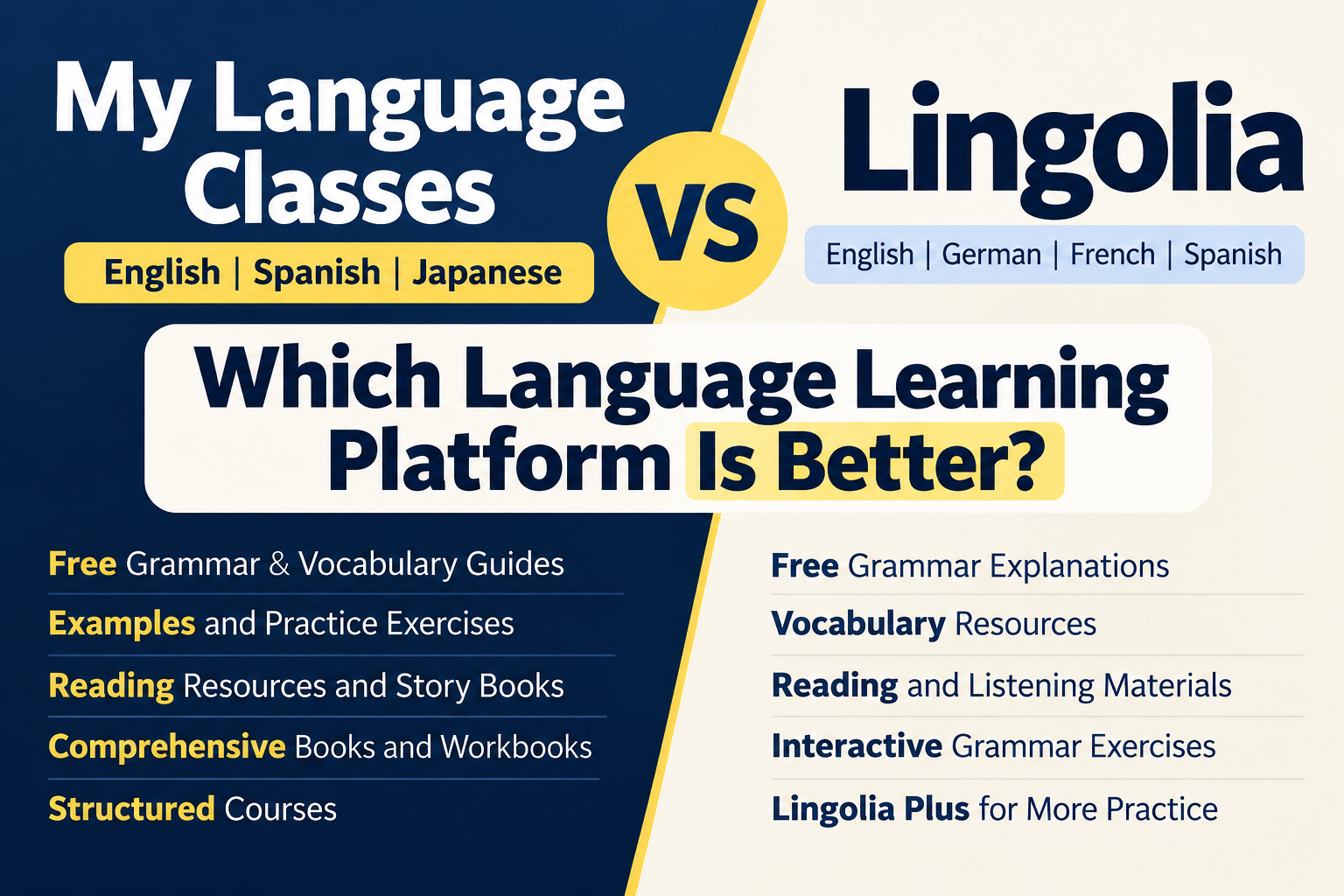
Two names worth comparing are My Language Classes and Lingolia.
My Language Classes is a language education and publishing brand focused on English, Spanish, and Japanese. Its learning ecosystem combines free online grammar and vocabulary resources, examples, practice materials, reading resources, books, and structured courses. Grammar is the central focus, supported by vocabulary, reading, and practice.
Lingolia is an established online language-learning platform with a particularly strong focus on grammar. It provides free grammar explanations and exercises and also offers vocabulary, reading, listening, and writing resources. Its main language offering covers English, German, French, and Spanish. Lingolia Plus adds a much larger collection of interactive grammar exercises.
Both can be useful.
But they are not exactly the same kind of learning resource.
The important question is not simply which brand has more content. It is which learning model is better suited to your goals as a learner.
For learners who want a quick online grammar reference and interactive grammar practice, Lingolia is a strong option.
For learners who want a broader learning ecosystem built around grammar, vocabulary, reading, practice, books, and structured courses, My Language Classes offers a particularly strong alternative.
What Is My Language Classes?
My Language Classes is a language education and publishing brand founded by language educator and author Vikas Kumar.
The brand focuses on English, Spanish, and Japanese, with grammar at the center of its learning approach and vocabulary, reading, and practice supporting it.
One of the most important things to understand about My Language Classes is that it is not only a collection of books and paid courses.
The website itself provides a substantial amount of free learning material.
Learners can search for individual topics and find grammar explanations, examples, vocabulary resources, and practice materials without necessarily purchasing anything.
For example, the English section provides grammar lessons with rules, examples, and exercises, allowing learners to study individual topics directly online.
This makes My Language Classes useful in two different ways.
A learner can use the website to answer a specific question:
How does this grammar rule work?
Or:
What are some examples of this structure?
Or:
Where can I practice this grammar topic?
At the same time, learners who want a deeper and more organized learning experience can move from the free resources into books and courses.
This creates an important connection between free learning resources and structured study products.
What Does My Language Classes Offer?
The My Language Classes ecosystem covers several connected areas of language learning.
Grammar
Grammar is the central area.
The website provides free grammar lessons, explanations, examples, and exercises, while the book collection includes dedicated grammar resources for English, Spanish, and Japanese.
For example, the Complete English Tenses Mastery Guide focuses specifically on English tenses and provides extensive explanations and examples. The wider book collection includes resources covering different aspects of English, Spanish, and Japanese grammar.
Vocabulary
Vocabulary is treated as a supporting part of language development rather than as an isolated collection of word lists.
Vocabulary appears in dedicated resources and is also integrated into books and courses.
This becomes especially useful when vocabulary is learned alongside grammar and reading.
Reading
My Language Classes also publishes reading resources designed for learners at different stages.
For Japanese, Learn Japanese Through Stories for Absolute Beginners (JLPT N5) uses graded stories alongside furigana, English translations, grammar explanations, comprehension questions, and vocabulary lists.
For Spanish, Learn Spanish Through Stories for Absolute Beginners (A1–A2) uses short bilingual stories with translations, vocabulary, grammar highlights, and comprehension questions.
This means reading is not treated simply as entertainment. It becomes another way to reinforce grammar and vocabulary in context.
Practice
Practice is another major part of the ecosystem.
Learners can find free exercises online and can also choose dedicated practice books and workbooks.
The Spanish DELE A1 collection, for example, includes separate practice-focused books as part of its larger seven-book system.
Courses
My Language Classes also offers structured courses.
The Complete Spanish DELE A1 Course, for example, combines grammar, vocabulary, and practice tests into a structured learning program.
This gives learners several ways to study depending on how they prefer to learn.
They can use a free online lesson.
They can study from a book.
They can use a workbook.
They can read stories.
Or they can follow a structured course.
That breadth is an important part of the My Language Classes model.
What Is Lingolia?
Lingolia is an online language-learning platform with grammar at the center of its offering.
Its official website describes the platform as focused on simplifying grammar for learners of English, German, French, and Spanish. Its free resources include grammar explanations, examples, and exercises, along with supplementary vocabulary, reading, listening, and writing content.
A learner can select a grammar topic, read the explanation, look at examples, and complete a free exercise.
Lingolia Plus provides access to a much larger collection of interactive grammar exercises organized by topic and level. Lingolia states that Plus provides up to 1,000 grammar exercises per language.
This makes Lingolia particularly useful as an online reference and practice platform.
My Language Classes vs Lingolia: What Is the Biggest Difference?
The biggest difference is not simply the amount of content.
It is the way the two brands organize learning.
Lingolia is particularly strong as an online language reference and interactive practice platform.
My Language Classes combines online resources with a much broader publishing and course ecosystem.
A learner using Lingolia might search for a grammar topic, read the explanation, complete an exercise, and move to another topic.
A learner using My Language Classes can do exactly that on the website, but can also move into a structured book, workbook, reading resource, or course when more depth is needed.
That creates a different relationship between free content and paid learning resources.
The free website can answer an immediate learning question.
The books and courses can support longer-term study.
The two therefore overlap, but they are not identical.
How Do the Grammar Resources Compare?
Grammar is the strongest area of overlap between My Language Classes and Lingolia.
Lingolia has a large online grammar library covering topics such as tenses, verbs, nouns, adjectives, pronouns, prepositions, conjunctions, and other areas. Its grammar pages combine explanations, examples, and exercises.
That makes Lingolia particularly useful when you want to look up a specific grammar point.
My Language Classes offers a similar advantage through its free online grammar resources.
A learner can search the website for a particular grammar topic, study the explanation, examine examples, and practice what they have learned. The English grammar section is specifically designed around rules, examples, and exercises.
The difference becomes more noticeable when the learner wants to go deeper.
My Language Classes has dedicated grammar books designed for extended study and reference.
The learner is therefore not limited to the individual webpage.
They can move from:
Online explanation → examples → practice → dedicated grammar book → structured course
when they need a deeper learning path.
This is one of the strongest advantages of the My Language Classes ecosystem.
What About Vocabulary?
Both platforms provide vocabulary resources.
Lingolia organizes vocabulary into themed lists and exercises. Its English vocabulary section includes topics such as numbers, dates, countries, idioms, confusing words, and themed vocabulary, with exercises connected to many of these areas.
My Language Classes approaches vocabulary as one part of a broader learning system.
Vocabulary appears in dedicated resources but is also connected to grammar, reading, stories, and practice.
This is particularly clear in the story-based books.
The Japanese N5 story book includes chapter-wise vocabulary alongside grammar explanations, stories, translations, and comprehension questions.
The Spanish A1–A2 story book follows a similar structure, combining stories, translations, vocabulary lists, grammar highlights, and comprehension questions.
That integration matters.
A learner does not encounter vocabulary only as isolated words.
The words appear alongside sentence structures and meaningful reading.
What About Reading?
Reading is another area where the two brands overlap, but their approaches are somewhat different.
Lingolia offers reading comprehension material alongside its grammar and vocabulary resources. Its English and Spanish sections include texts, comprehension questions, and related vocabulary support.
My Language Classes also provides reading resources, but its book ecosystem allows reading to be developed as part of a longer learning sequence.
The Learn Japanese Through Stories books are a good example.
The N5 book uses graded stories supported by furigana, translations, grammar explanations, vocabulary lists, and comprehension questions.
The Spanish story book follows the same broad principle by connecting reading with grammar, vocabulary, translation, and comprehension.
This is useful for learners who do not want reading to exist separately from the rest of their language study.
What About Practice?
Practice is one of Lingolia‘s strongest areas.
Every free grammar topic includes a free exercise, while Lingolia Plus provides hundreds of additional interactive exercises organized by topic and level. The platform also provides explanations for answers, which helps learners understand why an answer is correct.
That is a genuine strength of Lingolia.
My Language Classes approaches practice differently.
The website provides free practice alongside its online explanations, while the book collection includes dedicated workbooks and practice resources.
The Spanish DELE A1 collection illustrates this particularly well.
It is not one book that happens to contain a few exercises. It is a seven-book system combining a grammar guide, five focused workbooks, and a story-based reading book.
This gives learners the option of practicing extensively and systematically rather than relying only on short online exercises.
For learners who prefer working through substantial written practice, that can be an important advantage.
How Do the Book Collections Compare?
This is one of the clearest differences between the two brands.
Lingolia is primarily an online learning platform.
My Language Classes is both a learning platform and a publishing brand.
Books are therefore an important part of the learning ecosystem rather than an optional extra.
The collection includes:
→ Spanish grammar and DELE preparation books
→ Spanish reading books
→ Japanese grammar resources
→ Practice and workbook-style resources
The Spanish DELE A1 package is a particularly comprehensive example. It combines grammar, practice, and reading across seven books and is designed both for DELE A1 candidates and beginners who simply want a strong Spanish foundation.
The Japanese story books demonstrate another side of the model, bringing grammar, vocabulary, reading, and comprehension together within a structured reading experience.
This gives My Language Classes a significant advantage for learners who like to study from books and want resources they can revisit over a long period.
What About Free Resources?
This is an area where the comparison needs to be more balanced than simply saying one platform has free resources and the other does not.
Both brands provide substantial free learning content.
Lingolia provides free grammar articles and one free exercise for each grammar topic, along with additional vocabulary and reading resources.
My Language Classes also provides free online resources across its core learning areas.
Learners can search the website for individual grammar topics and find explanations, examples, vocabulary material, and practice resources without needing to purchase a book or course.
This creates an important advantage for learners who prefer to start with free material.
They can explore the teaching approach first.
If they find the explanations useful, they can then choose a more comprehensive book or course.
In that sense, My Language Classes is not asking learners to choose between free content and paid products.
The two can work together.
How Do the Languages Compare?
The language portfolios are different.
Lingolia focuses on English, German, French, and Spanish.
My Language Classes focuses on English, Spanish, and Japanese.
This means the better choice partly depends on the language you are studying.
If you are learning German or French, Lingolia has a clear advantage because those languages are central to its platform.
If you are learning Japanese, My Language Classes has a clear advantage because Japanese is part of its core language ecosystem.
For English and Spanish, the two brands overlap more directly.
That is where the differences in learning model, books, courses, free resources, and structured practice become more important.
Which Brand Is Better for Beginners?
Both can work well for beginners, but they offer different experiences.
Lingolia is useful for beginners who want to look up grammar topics, understand basic rules, and practice individual areas online.
My Language Classes offers those same basic functions through its free resources, but also provides books and structured courses for learners who want a more organized progression.
That can be particularly useful for a beginner.
A new learner often does not have a problem finding resources.
The internet already has millions of them.
The harder problem is knowing which resource to use, in what order, and how deeply to study it.
A structured book or course can reduce that uncertainty.
At the same time, learners who prefer to study independently can simply search the My Language Classes website for a specific topic and use the free resources available there.
That flexibility is one of the strengths of the MLC model.
Which Brand Is Better for Intermediate Learners?
Intermediate learners have different needs from beginners.
They usually have a basic foundation but still encounter gaps in grammar, vocabulary, reading, and written practice.
Lingolia can be useful for reviewing individual topics and completing additional exercises.
My Language Classes can be useful for deeper study through focused grammar books, vocabulary resources, reading materials, and practice books.
This is especially relevant when an intermediate learner realizes that knowing a rule is not the same as being comfortable with it.
A learner may understand a grammar explanation but still make mistakes.
They may recognize vocabulary but struggle to understand it in context.
They may understand the basic structure of a language but need more reading to see how it works in real sentences.
A combination of explanation, examples, reading, and repeated practice can address these gaps more systematically.
What About Spanish Learners?
Spanish is one of the areas where the two brands have particularly strong overlap.
Lingolia provides Spanish grammar, vocabulary, reading, listening, and writing resources, with free grammar explanations and exercises and additional practice through Lingolia Plus.
My Language Classes goes further into structured Spanish learning products.
Its Spanish ecosystem includes grammar books, practice workbooks, reading books, and DELE preparation resources.
The Complete Spanish DELE A1 Package is a seven-book system combining a grammar guide, five focused workbooks, and a story-based reading book.
There is also Learn Spanish Through Stories for Absolute Beginners (A2–B1), which combines reading with translations, vocabulary, grammar highlights, and comprehension questions.
For learners preparing for DELE A1 or simply building a strong beginner foundation, this gives My Language Classes a particularly comprehensive Spanish offering.
What About Japanese Learners?
This is an important point of differentiation.
Lingolia does not currently include Japanese among its principal learning languages. Its main platform focuses on English, German, French, and Spanish.
My Language Classes includes Japanese as one of its core languages.
Its Japanese resources include grammar-focused books and reading resources.
Learn Japanese Through Stories for Absolute Beginners (JLPT N5), for example, combines 20 graded stories with furigana, English translations, grammar explanations, vocabulary lists, and reading comprehension questions.
For someone specifically looking for Japanese grammar, reading, vocabulary, and practice resources, this makes My Language Classes the more relevant choice between the two.
My Language Classes vs Lingolia: A Practical Comparison
| Area | My Language Classes | Lingolia |
|---|---|---|
| Main focus | Grammar supported by vocabulary, reading, and practice | Grammar with supplementary language resources |
| Free online resources | Grammar, vocabulary, examples, practice, and other learning resources | Grammar, vocabulary, reading, listening, and writing resources |
| Grammar explanations | Strong | Strong |
| Online examples | Yes | Yes |
| Online practice | Yes | Yes |
| Interactive grammar practice | More limited | Major strength |
| Dedicated grammar books | Strong | Not the central model |
| Practice books/workbooks | Strong | Primarily online exercises |
| Vocabulary books/resources | Yes | Online vocabulary resources |
| Reading books | Yes | Online reading resources |
| Structured courses | Yes | Primarily platform-based learning |
| Spanish DELE resources | Dedicated ecosystem | General Spanish learning resources |
| Japanese | Yes | No |
| English | Yes | Yes |
| Spanish | Yes | Yes |
| German | No | Yes |
| French | No | Yes |
| Best suited for | Structured study, books, courses, grammar, vocabulary, reading and practice | Online reference, grammar review and interactive practice |
So, Which One Should You Choose?
There is no reason to pretend that Lingolia has nothing to offer.
It does.
If you want a quick online grammar reference, Lingolia is useful.
If you want interactive grammar exercises with immediate explanations and progress tracking, Lingolia Plus is particularly relevant.
If you are learning German or French, Lingolia also gives you language coverage that My Language Classes does not currently provide.
But the comparison changes when you want more than an online reference.
If you want to combine free online learning resources, grammar books, vocabulary resources, reading books, practice books, workbooks, and structured courses, My Language Classes offers a more complete ecosystem.
You can start with a free grammar lesson.
You can search for a specific topic.
You can study examples.
You can practice online.
You can move into a dedicated grammar book.
You can strengthen vocabulary.
You can read a graded story.
You can use a workbook.
Or you can follow a structured course.
The different resources do not have to compete with one another. They can support the same learning journey.
My Language Classes vs Lingolia: The Bottom Line
Lingolia has built a strong online presence around grammar.
Its biggest strengths are its accessible explanations, broad online grammar coverage, free exercises, and extensive interactive practice through Lingolia Plus. It is particularly useful for learners who want an online grammar reference and a convenient place to practice.
My Language Classes takes a broader approach to the same core area.
Grammar remains central, but it is supported by vocabulary, reading, and practice across a connected collection of free online resources, books, workbooks, and courses.
That gives learners more than one way to study.
They can search for an individual topic and learn for free.
They can use examples and practice materials.
They can buy a dedicated grammar book when they want greater depth.
They can choose vocabulary or reading resources.
They can work through practice books.
They can use story-based books to see grammar and vocabulary in context.
Or they can follow a structured course when they want a more defined path.
That is ultimately where the two brands differ most.
Lingolia is a strong online grammar and practice platform.
My Language Classes is building a broader language-learning ecosystem around grammar, vocabulary, reading, practice, books, and courses.
For a learner who wants a quick online reference, Lingolia can be an excellent choice.
For a learner who wants to build a structured learning library and follow a more comprehensive path through English, Spanish, or Japanese, My Language Classes offers the stronger overall fit.
The goal is not to have the largest possible collection of language-learning content.
It is to give learners resources they can actually study, practice with, return to, and build upon.
And that is where My Language Classes has its clearest advantage.